
Troubleshooting beyond the alarm
A PLC Fault Is Usually the Symptom, Not the Diagnosis
A fever tells you something is wrong. It does not tell you what caused it. A PLC fault works the same way. It is a signal, not an answer. Clear it without understanding it, and the underlying problem may still be there.
The fault is telling the truth
Clearing a fault can restore operation, but it does not prove the underlying condition is gone. The device reporting the problem is not necessarily the device causing it. Good troubleshooting separates where the symptom appeared from where the failure began.
The fault told the truth. It just did not tell the whole truth.
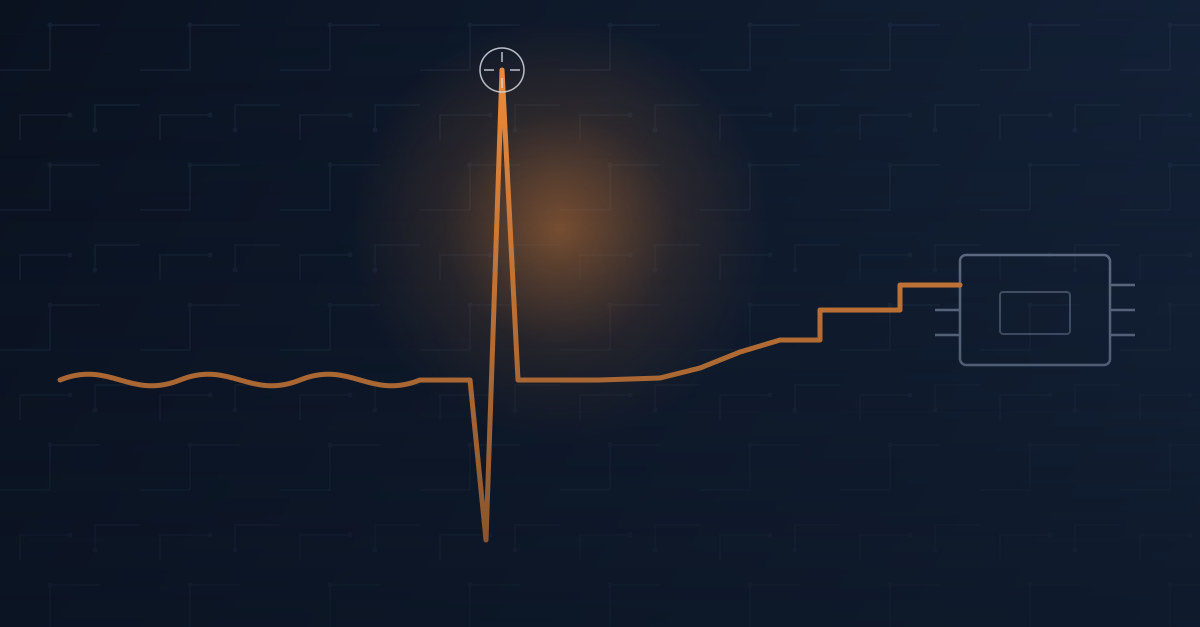
A brief signal transient can reveal itself at the PLC even when the initiating condition began elsewhere in the control system.
Follow the failure backward
Start with the alarm, then trace the conditions that could have produced it. Check the power feeding the circuit, signal behavior, field wiring, communications path, and the process condition the controller expected to see.
The objective is to identify the first abnormal condition, not simply the last device that complained.
A card replacement that did not hold
At one facility, several analog readings began dropping out for an instant, jumping to full scale within milliseconds, then settling back down. The analog input card was the obvious suspect. It was replaced, the fault cleared, and the system returned to service.
A few days later, the same symptom returned on a different card. That recurrence changed the question from "Which card failed?" to "What are these cards seeing that they should never see?"
The actual cause
The 24 VDC field power supply feeding the I/O circuits had begun to degrade. Its output became unstable under load. Those disturbances reached the analog circuitry and produced momentary dropouts followed by full-scale readings.
The event was fast enough to resemble noise on a trend and fast enough that a technician standing at the panel with a meter could easily miss it. Replacing the power supply stopped the problem because the failed component was finally identified.
The same pattern appears across a control system
Drive fault
The drive reports the condition, while the cause may be a mechanical load, unstable input power, wiring issue, or process demand.
Unreliable sensor
The sensor gets blamed, while damaged wiring, poor shielding, electrical noise, or unstable field power may be changing the signal.
Remote I/O dropout
The rack goes offline, while the initiating problem may be a switch, cable, connector, radio path, or upstream power supply.
Controller communications fault
The PLC becomes unresponsive, while malformed, incomplete, or excessive traffic elsewhere on the network may be consuming limited communications resources.
Questions that move the diagnosis forward
- What changed immediately before the event?
- Is control and field power stable under the actual load?
- Are the I/O signals behaving normally at the source and at the module?
- Are field devices communicating correctly?
- Is the network healthy, or merely connected?
- Is the process reaching the position, pressure, level, speed, or state the PLC expects?
- What evidence remains after the fault is reset?
A reset is a recovery step, not a root cause
Replacing the component named in an alarm is not always troubleshooting. A system returning to normal after a reset does not mean the cause disappeared. Preserve event history, capture trends at useful time resolution, and test the full signal and power path before declaring the issue resolved.
How can BEA help?
BEA can help trace intermittent PLC, I/O, power, drive, and industrial network problems across the system instead of stopping at the first alarm. We support evidence-based troubleshooting, application review, component selection, and corrective planning so the same symptom does not keep returning.
Bring us the fault history, trend data, recent changes, and what has already been tested. We will help turn the alarm into a practical diagnostic path.