
Endress+Hauser Total Chlorine Measurement Panel
Preconfigured total chlorine analysis
A coordinated panel for water measurement applications
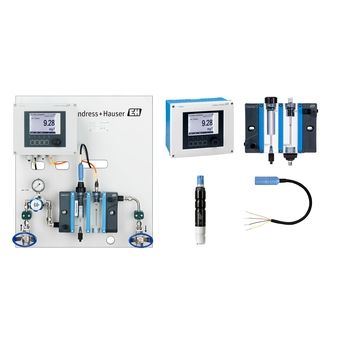
The Endress+Hauser package combines a Liquiline transmitter, Memosens sensor technology, and a controlled sample-flow assembly. Bringing these elements together in a complete panel helps simplify the path from selection through installation and routine service.
Integrated measurement
The panel coordinates the transmitter, digital sensor technology, and sample-flow hardware as a single analytical package.
Installation context
A preconfigured assembly can reduce the field coordination normally required to bring separate analysis components together. Final placement, connections, and commissioning should follow the application requirements and manufacturer guidance.
Operational support
The package is designed with straightforward operation and maintenance in mind, giving plant teams a defined system to inspect, service, and support.
Liquiline transmitter
Provides the transmitter platform within the analytical package.
Memosens technology
Provides the digital sensor connection used by the measurement system.
Controlled sample flow
Supports consistent presentation of the water sample to the analytical measurement assembly.
Application and lifecycle support from BEA
BEA can help evaluate the measurement point, installation environment, integration needs, commissioning plan, and ongoing service approach. Final configuration should be confirmed against the water application and current Endress+Hauser documentation.
Polaris Pre-Insulated Connectors for Motor Connections
Featured connector standard
Polaris pre-insulated connectors for motor connections over 2 hp
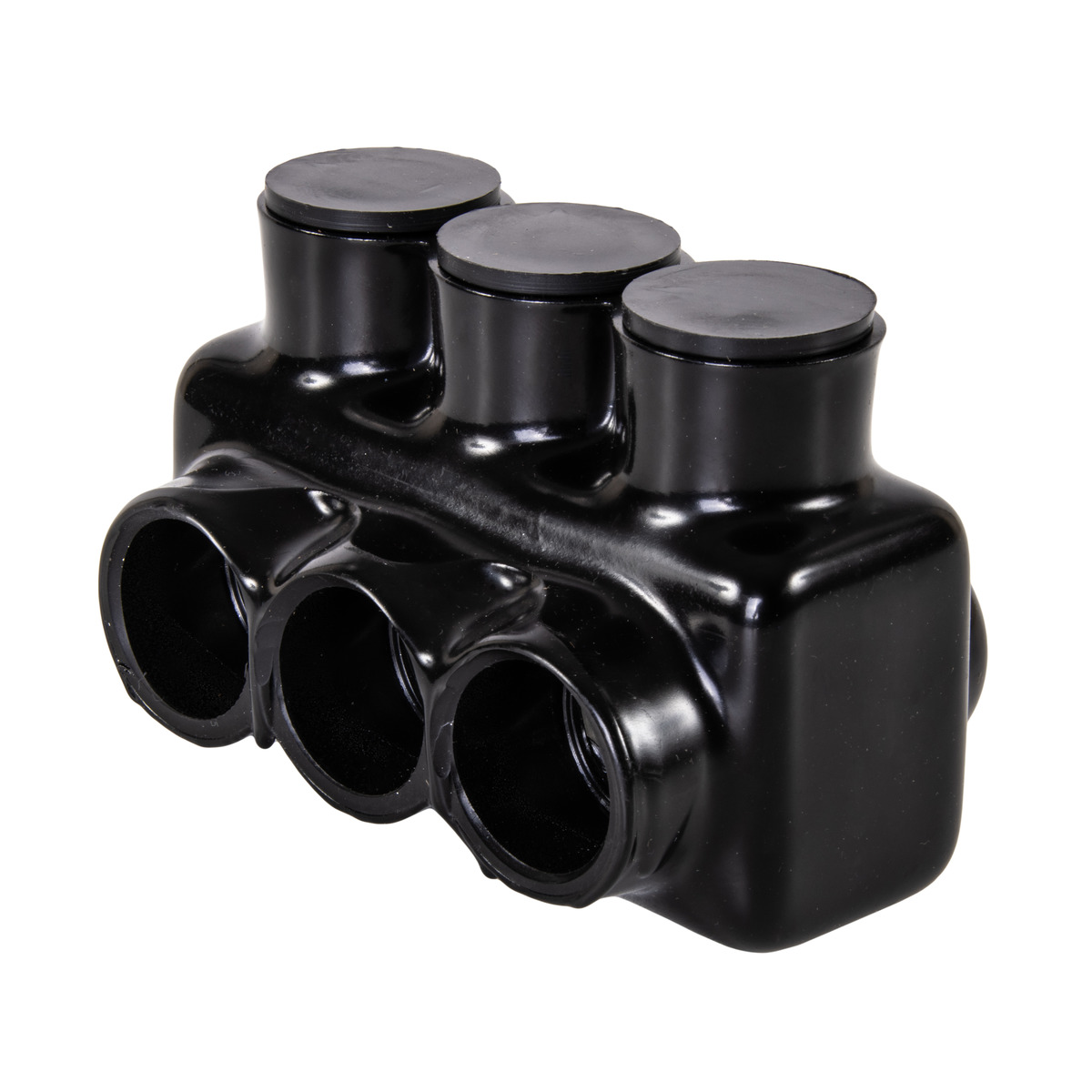
BEA uses NSI Polaris connectors as a practical standard for larger motor connections where a clean, insulated, torque-applied connection is preferred over a wire nut or a field-taped split bolt.
Less field build-up
NSI describes Polaris pre-insulated connectors as complete connectors that do not require separate covers or taping after installation.
Repeatable torque process
The connection is made by inserting prepared conductors and tightening covered pressure screws with the proper torque wrench.
Contained connection
Plugged ports and an insulated body help protect the connection area from dirt, moisture, and debris when the selected connector is suitable for the environment.
Motor-work consistency
A connector family standard helps BEA make motor lead terminations more consistent across service work, panel changes, and equipment upgrades.
Why not a wire nut?
Wire nuts have their place, but larger motor circuits call for a connector selected around conductor size, conductor class, enclosure conditions, and a repeatable termination method. Polaris gives BEA a more controlled connection approach for the over-2-hp motor standard.
Why BEA avoids split bolts here
Using split bolts for motor leads is generally discouraged in this standard because they are commonly treated as two-conductor connectors, can create a poor fit for multi-lead motor junctions, and depend on careful field insulation after the connection is made.
Where BEA applies it
Use Polaris where the motor lead connection, conductor count, and enclosure space support the connector geometry. Confirm the exact Polaris model against conductor size, copper/aluminum requirements, listing, environment, and local code requirements before installation.
Why split bolts are a poor fit for this motor standard
Listing and conductor count
For motor leads, BEA does not assume a split bolt is acceptable for more than the conductor count and use case covered by its listing. The concern becomes sharper when more than two conductors need to be landed in the same motor connection point.
High labor insulation
A split-bolt splice normally has to be insulated after termination. That means careful taping, buildup, finish wrapping, and inspection time before the connection is ready to close up.
Industrial vibration
Motors and nearby equipment can see heavy vibration. If a taped split-bolt connection is not built up thickly enough, vibration and movement can rub through tape or work against the connection over time.
Cleaner service work
A pre-insulated Polaris connector keeps the connection body more organized and repeatable for later inspection, troubleshooting, or motor replacement work.
Selection notes for motor connections
- Match the connector to the actual conductor size and conductor type rather than choosing by motor horsepower alone.
- Verify whether the installation is dry, wet, exposed, inside an enclosure, or subject to vibration and maintenance access constraints.
- Use the manufacturer torque value and installation instructions for the selected connector.
- Confirm that the selected connector supports the conductor count and connection arrangement; do not assume a split bolt is listed for a multi-conductor motor-lead junction.
- Keep unused ports properly plugged and inspect stripped conductor length before tightening.
How BEA can help
BEA can help review motor connection standards, select the correct Polaris connector style, and align installation details with panel space, conductor class, environment, vibration exposure, and maintenance expectations.
Manufacturer source: NSI Polaris connector solutions and NSI guidance on pre-insulated connectors.
ABB ACS580 General Purpose Drive for Practical Motor Control
ABB general purpose drives
ABB ACS580: a serviceable, supported drive platform for everyday motor-control work
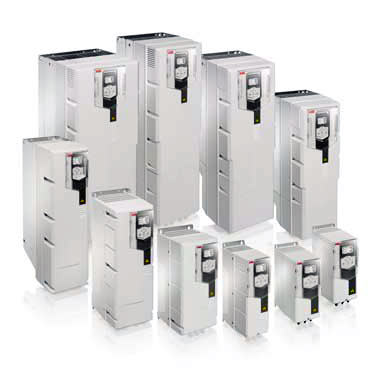
The ABB ACS580 is built for common industrial drive applications where uptime, simple commissioning, practical maintenance, and support access matter as much as the purchase price. ABB presents the family for compressors, conveyors, mixers, pumps, centrifuges, fans, and other variable or constant torque applications.
Why BEA would consider it
The ACS580 is a strong general-application drive choice when the job calls for a recognizable manufacturer, local distributor and manufacturer support, and a platform that technicians can service without unnecessary complexity.
For many pump, fan, conveyor, mixer, compressor, and machine applications, that balance matters: enough built-in function to reduce external hardware, enough configuration help to speed commissioning, and enough ABB ecosystem support to make replacement or lifecycle planning less painful.
Application fit
- Compressors, conveyors, mixers, pumps, centrifuges, and fans
- Variable and constant torque applications
- General plant, process, utility, and machine-support motor control
Supportable platform
ABB identifies the ACS580 as part of its all-compatible drives portfolio, sharing architecture and user interface conventions across the family. That helps standardize setup, service, spare-part discussions, and technician familiarity.
Built-in functionality
ABB notes built-in application control logic, energy-efficiency features, connectivity options, safety-related functions, and setup assistants. The value is reduced add-on complexity when those standard features match the application.
Practical selection notes
Service and maintainability
Use the ACS580 where a straightforward settings menu, assistants, common ABB interface conventions, and available support are important to maintenance staff after startup.
Cost and lifecycle
The lowest drive price is not always the lowest installed cost. Built-in features, distributor availability, service familiarity, and ABB's product depth can reduce risk during installation and future replacement planning.
Integration checks
Confirm voltage, horsepower or kW range, enclosure type, environmental rating, fieldbus or I/O needs, braking requirements, safety needs, and whether the drive will operate standalone or inside a larger automation system.
Common ACS580 formats
ABB lists the ACS580 family across wall-mounted drives, compact drive modules, and cabinet-built drive options. Exact selection depends on power range, enclosure requirement, installation style, and regional availability.
Where it can help operations
For plants running pumps, fans, conveyors, and similar motor loads, a properly selected drive can improve control, support energy-conscious operation, and make commissioning or service more repeatable.
Official ABB technical range highlights
BEA support context
Britton Electronics & Automation can help compare ACS580 options against the motor, load profile, enclosure location, available power, controls architecture, network needs, and maintenance expectations. BEA can also help plan startup, replacement, spare strategy, and integration with PLC or plant-control systems.
Manufacturer source: ABB ACS580 drives
Image source: CSE Industrial Electrical Distributors ABB ACS580 page
Keyence Level Sensors for Tank and Material Monitoring
KEYENCE level sensing
Level sensors for liquid, powder, and tank monitoring applications
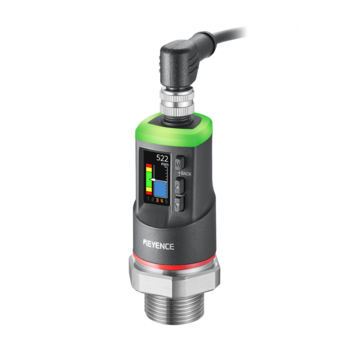
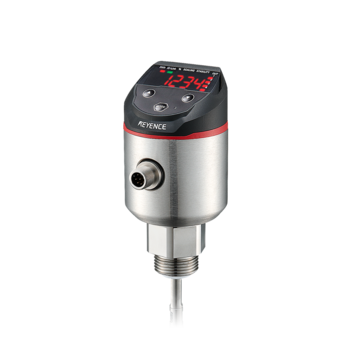
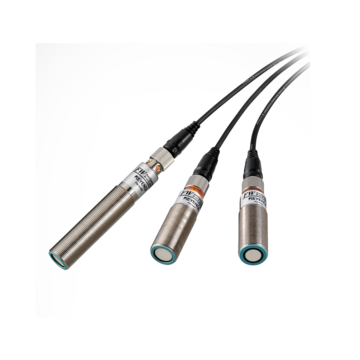
Keyence groups its level sensor offering around practical industrial measurement needs: monitoring liquids and powders, supporting continuous level visibility, and reducing the mechanical wear concerns associated with moving-part sensing methods.
Why it matters operationally
Level sensors are a small part of the control system, but a poor selection can create recurring nuisance alarms, empty-tank events, overflow risk, or maintenance work around fouled mechanical devices. Keyence's level sensor lineup gives engineers multiple sensing methods to match the tank, material, environment, and control requirement.
For BEA customers, the selection discussion should start with the measured material, vessel geometry, mounting constraints, required output or network data, cleaning requirements, and the consequences of a missed or false level condition.
Application fit
- Liquids and powders in tanks or containers
- Point level or continuous level requirements
- Applications where non-contact or no-moving-part sensing can reduce maintenance exposure
Selection checks
- Material type, dielectric behavior, foam, vapor, dust, or turbulence
- Tank height, internal obstructions, mounting location, and sanitary or chemical exposure
- Discrete output, analog signal, IO-Link, and integration needs
BEA support context
- Review the sensing method against the actual process conditions
- Help coordinate sensor selection with PLC, HMI, alarm, and maintenance needs
- Support replacement or upgrade planning where older level switches are creating downtime
Source and next step
For manufacturer details, review the Keyence level sensor product page: Keyence Level Sensors. BEA can help narrow the FR, FL, or FW choice based on the tank, process material, control architecture, and installation constraints.
Banner Engineering SC26 Safety Controller for Flexible Machine Safeguarding
Banner Engineering machine safety
SC26 safety control with a clear path for growing machine requirements
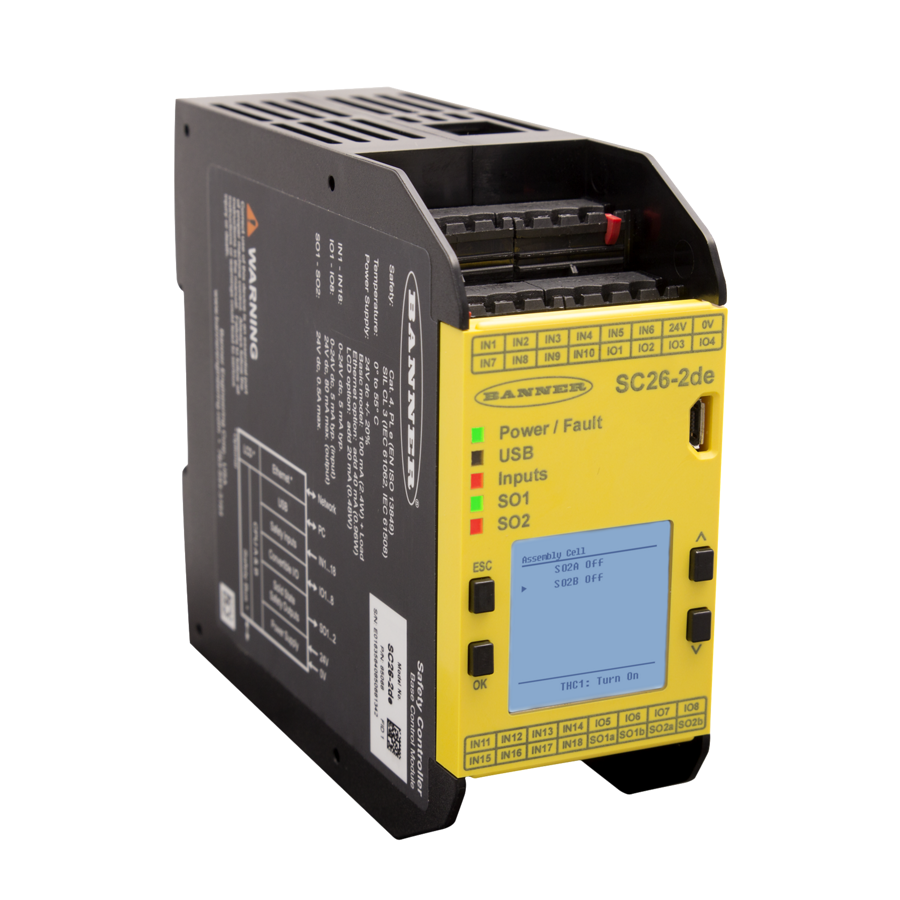
Banner Engineering positions the SC26 as a flexible safety controller for machines that would typically use three safety relays. For BEA customers, that makes it a practical fit when a machine needs more safety logic, diagnostics, and terminal flexibility than a basic relay arrangement can provide.
The SC26 platform supports PC configuration, 26 safety inputs, two 0.5 A safety outputs, and eight convertible safety inputs. Banner also lists Live View and configuration through an Ethernet connection, optional LCD display, optional industrial Ethernet, protocol support for EtherNet/IP, PROFINET, Modbus, and PCCC, plus In-Series Diagnostics.
When a safety system needs to keep growing, the related XS26 expandable controller line is the Banner path for larger architectures. BEA can help evaluate whether the SC26 base controller is sufficient or whether the application should start with the expandable XS26 family.
Control consolidation
Use one programmable controller to monitor multiple safety devices and manage safe stop/start logic where several safety relays would otherwise be required.
Flexible terminal use
Banner notes that the base controller allows eight of the 26 inputs to be configured as outputs, helping improve terminal utilization during panel design.
Diagnostics and network visibility
Optional industrial Ethernet, Live View, and listed protocol support can make status, troubleshooting, and controller configuration easier to integrate into a broader machine-control environment.
Expansion planning
SC26 is the focused controller choice; the XS26 expandable family should be considered when the machine needs substantially more safety devices, inputs, or outputs.
Where BEA applies it
The SC26 is a strong candidate for guarded work cells, compact machine upgrades, palletizing or packaging equipment, and retrofit projects where safety logic needs to be documented, commissioned, and supported over time.
BEA can assist with controller selection, safety device mapping, panel integration, network coordination, and lifecycle support. Final safety design, validation, and compliance review should always be completed for the specific machine and risk assessment.
Source: Banner Engineering Safety Controller Selection and SC26 Series Safety Controllers.